Trekking poles are one of those pieces of gear that many beginners think they can skip.
And for an easy walk, you probably can.
But Himalayan trails are different. Long climbs, steep descents, loose rocks, muddy forest sections, snow and stream crossings can make a trekking pole far more useful than it looks in the store.
At Montaxe, we look at trekking poles from a practical Himalayan trekking perspective: how useful they are on actual trails, whether beginners really need them, and whether spending more money genuinely gives you a better experience.
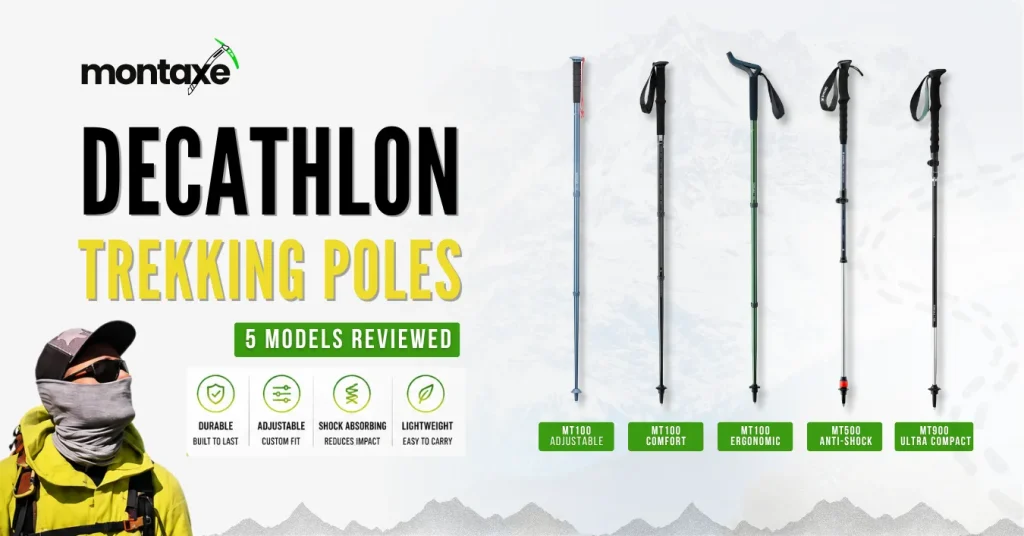
For this review, we compared five Decathlon trekking poles currently available in India: the MT100 Adjustable, MT100 Comfort, MT100 Ergonomic, MT500 Anti-Shock and MT900 Ultra Compact.
Montaxe Quick Verdict
Are trekking poles worth carrying? Yes, especially for multi-day Himalayan treks with long climbs and descents.
- Best Budget Pick: Decathlon MT100 Adjustable
- Best for Beginners: MT100 Adjustable
- Best Overall for Regular Trekkers: MT500 Anti-Shock
- Best for Compact Packing: MT900 Ultra Compact
- Best for Ergonomic Grip: MT100 Ergonomic
Our Recommendation
If you are buying your first trekking pole, start with the MT100 Adjustable.
If you trek several times a year and want better adjustment, grip and comfort, the MT500 Anti-Shock is the strongest all-round option in this group.
The MT900 makes the most sense for frequent trekkers who care about compact packing and regularly travel with their own gear.
Pros and Cons
Pros
- Adds stability on uneven Himalayan trails
- Particularly useful on steep descents
- Helpful on mud, snow, loose rocks and stream crossings
- Can make walking with a loaded backpack more comfortable
- Decathlon offers options from budget to premium
- Entry-level MT100 is inexpensive enough for beginners to try
- MT500 and MT900 offer better features for regular trekkers
Cons
- One or both hands remain occupied while using poles
- Beginners need some time to develop proper technique
- Poles can get caught between rocks if placed carelessly
- Premium models become expensive when buying a pair
- Not every section of a trek requires a trekking pole
- A trekking pole does not replace technical equipment when the terrain requires it
Quick Comparison
| Model | Approx. Price* | Weight | Best For |
| MT100 Adjustable | ₹499 | ~200 g | Beginners |
| MT100 Comfort | ₹999 | – | Occasional trekkers |
| MT100 Ergonomic | ₹999 | ~240 g | Ergonomic grip |
| MT500 Anti-Shock | ₹1,999 | ~245 g | Regular Himalayan trekking |
| MT900 Ultra Compact | ₹2,599 | ~275 g | Frequent trekkers & compact packing |
*Prices can change. Always check the current Decathlon India listing before purchasing.
One important thing to remember: these Decathlon trekking poles are generally sold individually, not as pairs.
Do You Really Need a Trekking Pole?
A trekking pole is not compulsory for most recreational Himalayan treks.
But that doesn’t mean it isn’t useful.
On mountain trails, you may encounter:
- Long uphill sections
- Steep descents
- Loose rocks
- Mud
- Snow
- Slippery roots
- Uneven forest trails
- Stream crossings
- Several hours of walking with a backpack
A trekking pole gives you another point of contact with the ground.
That can improve balance and confidence, particularly when you are tired or walking on unstable terrain.
For many trekkers, the biggest advantage becomes noticeable while descending. After several hours on the trail, your legs are already fatigued, and every downward step requires additional control.
Research on downhill walking has also found that correctly used trekking poles can reduce some measures of loading around the knees and lower limbs.
That does not mean trekking poles prevent injuries, but there is a practical reason why experienced trekkers often carry them on long mountain routes.
1. Decathlon MT100 Adjustable Trekking Pole
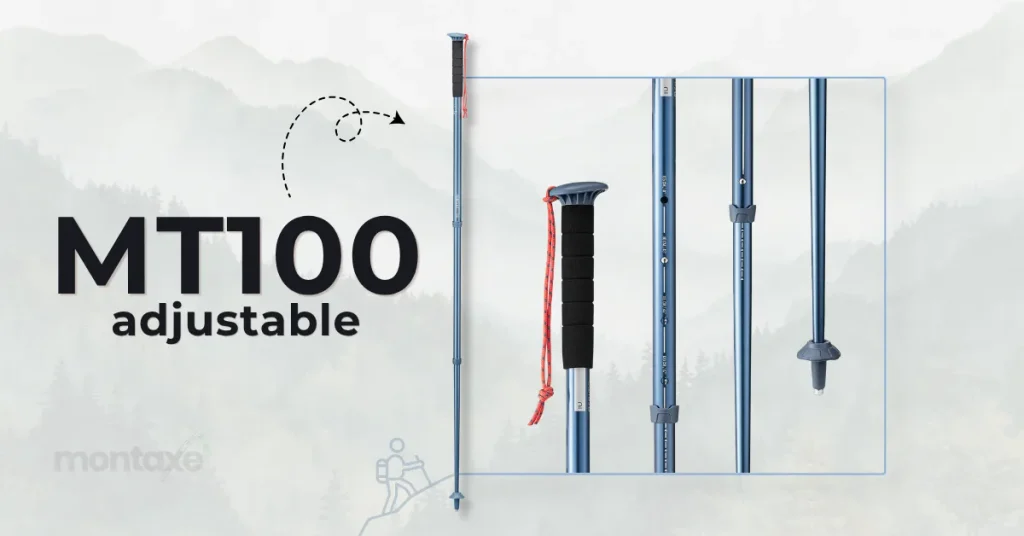
The MT100 Adjustable is the entry-level option and probably the most sensible starting point for a beginner.
It weighs approximately 200 grams, uses aluminium sections and has a simple fixed-position adjustment system.
It is designed to do the basic job of a trekking pole without adding unnecessary features.
What We Like
Very Affordable
At around ₹499, it allows beginners to try trekking with a pole without making a large investment.
This matters because not everyone enjoys using trekking poles.
Some trekkers immediately appreciate them, while others prefer walking without one on easier terrain.
Simple Adjustment
The fixed-position push-button system is easy to understand.
There is very little that can go wrong operationally.
Lightweight Enough for Beginners
At around 200 grams per pole, it doesn’t add much weight to your trekking setup.
What We Don’t Like
The adjustment system is basic.
You cannot fine-tune the length as precisely as on more advanced poles.
The grip, strap and construction are also simpler than the MT500 and MT900.
Montaxe Verdict
For a first Himalayan trek, this is enough for most beginners.
You don’t need to spend ₹2,000–₹2,500 on your first trekking pole simply because those models have more features.
Best for: Beginners and occasional trekkers
Montaxe Rating: 8/10
2. Decathlon MT100 Comfort Trekking Pole
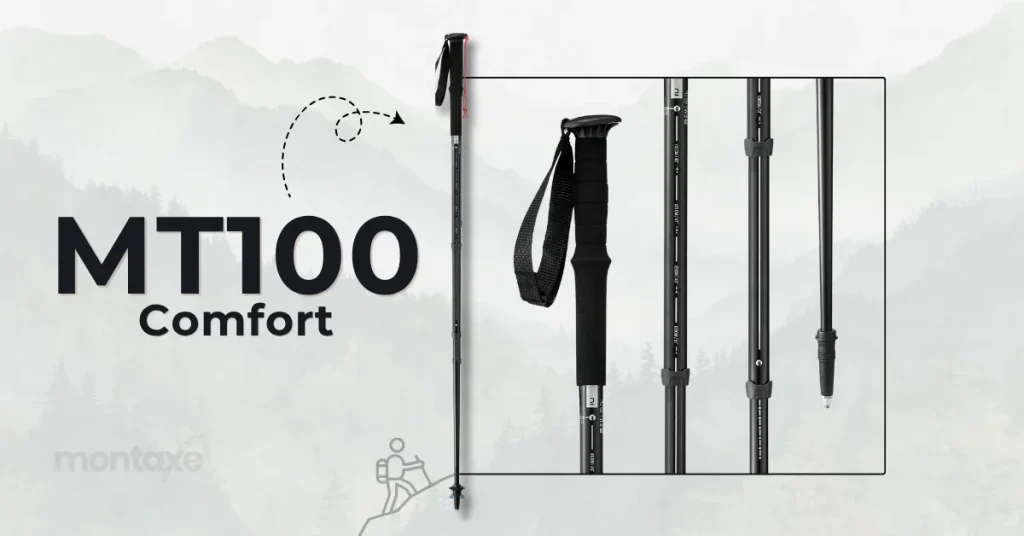
The MT100 Comfort sits between the entry-level MT100 and Decathlon’s more technical options.
Its main purpose is exactly what the name suggests: slightly greater comfort for people who hike or trek occasionally.
Who Is It For?
Consider this model if:
- You trek occasionally
- Comfort matters more than buying the cheapest option
- You want a simple trekking pole
- You don’t need a highly compact folding design
Montaxe Verdict
The MT100 Comfort is a reasonable option, but at around ₹999 the decision becomes less obvious.
If you expect to trek regularly, we would consider spending more once and moving toward the MT500 rather than upgrading repeatedly.
Best for: Occasional trekkers wanting more comfort
Montaxe Rating: 7.5/10
3. Decathlon MT100 Ergonomic Trekking Pole
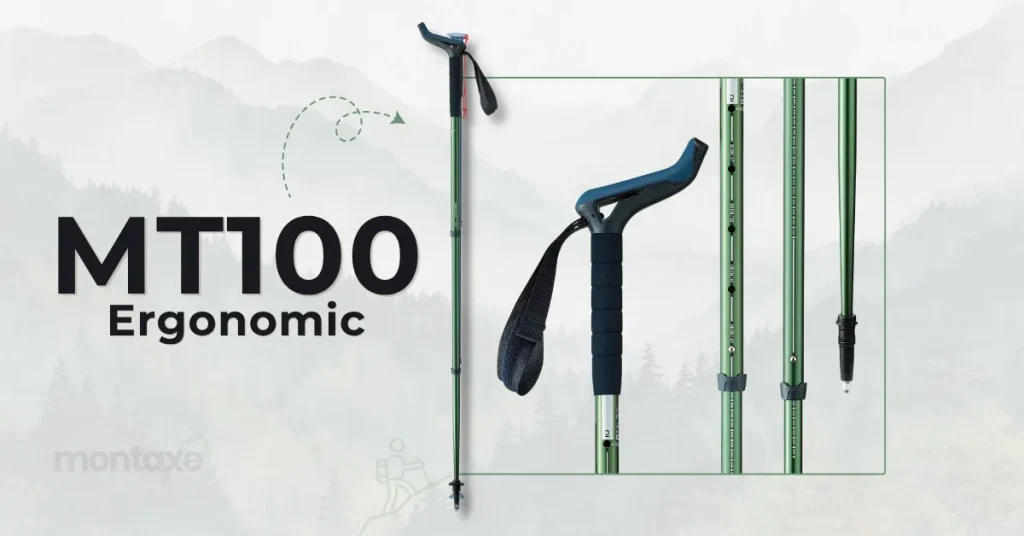
The MT100 Ergonomic is quite different from a traditional trekking pole.
Instead of the usual straight trekking-pole grip, it uses a more cane-like ergonomic handle.
That makes it particularly interesting for people who don’t find conventional pole grips comfortable.
The pole weighs approximately 240 grams and uses a telescopic aluminium construction.
What We Like
Different Grip Design
The ergonomic grip is the main reason to choose this pole.
Some users prefer placing more of the palm over the top of the handle instead of holding a traditional trekking grip.
Easy for Recreational Walking
The handle design can feel natural during less technical hiking and recreational walking.
What We Don’t Like
This would not automatically be our first recommendation for long Himalayan trekking.
The grip design is more specialised, and some trekkers may prefer the control provided by a traditional trekking-pole handle.
Montaxe Verdict
Choose this model because you genuinely prefer the grip.
Don’t choose it simply because it costs more than the basic MT100.
Best for: Trekkers who prefer a cane-style ergonomic handle
Montaxe Rating: 7.5/10
4. Decathlon MT500 Anti-Shock Trekking Pole
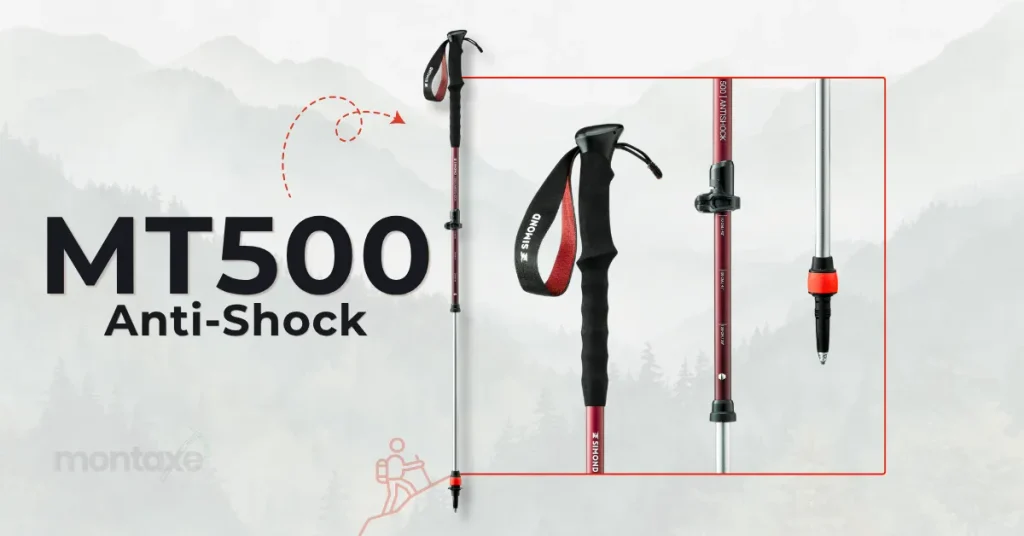
For regular Himalayan trekkers, this is where the range starts becoming much more interesting.
The MT500 Anti-Shock weighs approximately 245 grams and offers a more precise adjustment system than the entry-level models.
It also has a longer foam grip and an impact-absorbing mechanism.
What We Like
Better Length Adjustment
Mountain terrain changes constantly.
You may want your pole slightly shorter while climbing and slightly longer while descending.
The MT500 gives you better control over pole length than the fixed-position entry models.
Long Foam Grip
This is genuinely useful on Himalayan terrain.
Instead of stopping every few minutes to adjust pole length, you can simply move your hand higher or lower on the extended grip for short sections.
Anti-Shock System
The anti-shock system provides a small amount of cushioning when the pole repeatedly strikes the ground.
Don’t expect dramatic suspension.
The effect is subtle, but on long trekking days repeated impacts add up.
Better Tip
The MT500 uses a tungsten tip, which is more suitable for repeated outdoor use than the simpler entry-level construction.
What We Don’t Like
The pole still isn’t particularly compact when collapsed.
That is perfectly fine when strapped outside a trekking backpack, but travellers who want everything packed neatly inside their bag may prefer the MT900.
The price is also significantly higher than the MT100, particularly if you buy two.
Montaxe Verdict
This is the sweet spot of the range for regular Himalayan trekkers.
You are paying for features that can genuinely improve the experience on longer and more demanding trails.
Best for: Regular trekkers
Montaxe Rating: 9/10
5. Decathlon MT900 Ultra Compact Trekking Pole
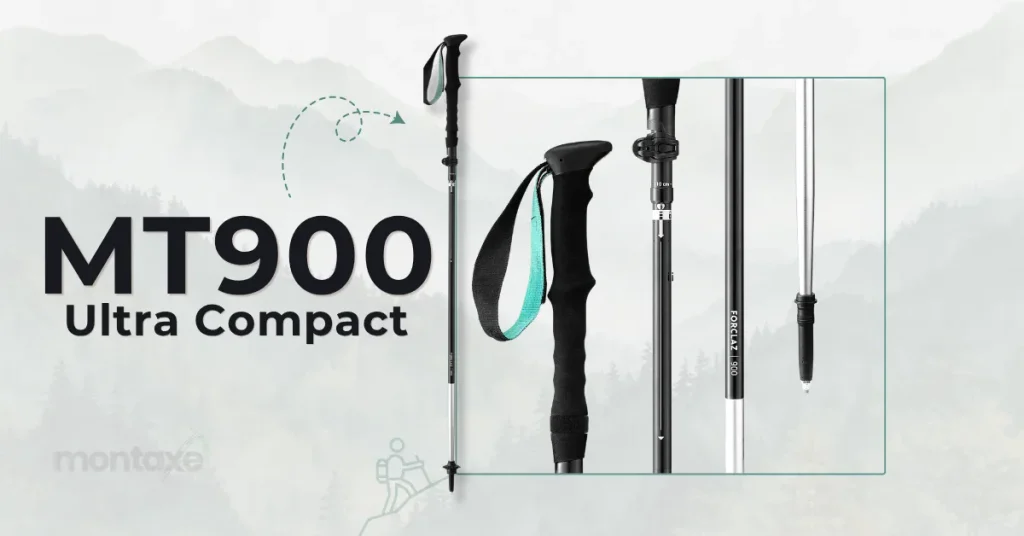
The MT900 is the premium option among these five.
Its biggest advantage is not simply that it costs more.
It is the way it packs.
The MT900 uses a folding multi-section construction and collapses to approximately 36 cm, making it considerably easier to pack than traditional telescopic poles.
It weighs around 275 grams per pole.
What We Like
Excellent Packability
This is the strongest reason to choose the MT900.
Its compact folded size makes it easier to:
- Fit inside a trekking backpack
- Carry during flights
- Pack during road travel
- Store when the trail becomes easy
- Carry on trips where luggage space matters
Long Grip
Like the MT500, it offers an extended grip that makes changing hand position easier on varied terrain.
Built for Frequent Use
The overall construction is more appropriate for people who trek regularly and travel frequently with their equipment.
What We Don’t Like
The price.
At around ₹2,599 per pole, buying two takes you beyond ₹5,000.
For someone doing one or two recreational treks a year, that may not offer enough additional value compared with the MT100 or MT500.
Montaxe Verdict
The MT900 is not automatically the best option just because it is the most expensive.
Its real advantage is compactness and convenience.
If you regularly travel with trekking equipment, that can be worth paying for.
Best for: Frequent trekkers and travellers
Montaxe Rating: 8.5/10
MT100 vs MT500 vs MT900: Which One Should You Buy?
Choose the MT100 Adjustable if:
- This is your first trekking pole
- You trek only occasionally
- Budget matters
- You want something simple
- You aren’t yet sure whether you like using poles
Choose the MT500 Anti-Shock if:
- You trek several times a year
- You want better adjustment
- Long descents are common on your treks
- You value the longer grip
- You want a good balance between price and features
Choose the MT900 if:
- You trek frequently
- You carry your own equipment
- You travel often
- Compact packing is important
- You are willing to pay more for convenience
For most regular Himalayan trekkers, we would choose the MT500.
One Trekking Pole or Two?
This depends on the trekker.
For many recreational trekkers, one trekking pole is enough to make a noticeable difference.
It can help with:
- Stream crossings
- Loose rocks
- Muddy sections
- Steep descents
- Balance when tired
Two poles provide more symmetrical support and allow both sides of the body to contribute.
They can be particularly helpful during long climbs and descents.
If you’re buying trekking poles for the first time and aren’t sure what you prefer, starting with one is perfectly reasonable.
How to Adjust a Trekking Pole Correctly
On relatively level terrain, start with the pole adjusted so that your elbow is around a right angle while holding the grip.
From there:
While Climbing
Shorten the pole slightly.
While Descending
Lengthen it slightly.
While Traversing a Slope
The uphill pole can be shorter than the downhill pole.
On models with a long foam grip, you can often change your hand position temporarily rather than adjusting the pole every time the terrain changes.
There is no single perfect trekking-pole length for an entire Himalayan trek.
Where Trekking Poles Are Most Useful
Long Descents
This is probably where most trekkers appreciate them the most.
Your legs are already tired, and the pole provides another contact point while controlling each downward step.
Loose Rocky Terrain
A pole can help you establish balance before committing your full body weight to the next step.
Muddy Forest Trails
Wet Himalayan forest sections can become slippery very quickly.
A pole can provide valuable extra support.
Snow
Trekking poles can improve balance on snow.
Depending on conditions, suitable snow baskets may also be required.
Remember that trekking poles are not substitutes for technical equipment such as an ice axe when the route requires one.
Stream Crossings
A trekking pole can help test the riverbed and provide additional support while crossing shallow streams.
Himalayan Treks Where We Would Carry a Trekking Pole
We would consider carrying one on treks such as:
- Kedarkantha
- Brahmatal
- Kuari Pass
- Dayara Bugyal
- Gulabi Kantha
- Kashmir Great Lakes
- Hampta Pass
- Bhrigu Lake
- Valley of Flowers
- Bali Pass
- Chopta–Tungnath–Chandrashila
That does not mean you need to use the pole for every kilometre.
Use it when the trail requires it and pack or attach it to your backpack when walking becomes straightforward.
Should Beginners Spend ₹2,000–₹2,500 on a Trekking Pole?
Usually, no.
If you are preparing for your first Himalayan trek, we would prioritise spending your budget on:
- Good trekking shoes
- Proper clothing layers
- Rain protection
- A suitable backpack
- Quality trekking socks
- Essential accessories
A premium trekking pole comes after those basics.
That is why the basic MT100 is such a useful entry-level option.
You can learn whether trekking with a pole suits you without spending much.
If trekking becomes a regular part of your life, upgrading to the MT500 or MT900 later makes more sense.
Which Decathlon Trekking Pole Would Montaxe Choose?
For a Beginner
MT100 Adjustable
Simple, affordable and capable of doing the basic job.
For a Regular Himalayan Trekker
MT500 Anti-Shock
This is our overall pick.
Its improved adjustment, longer grip and anti-shock mechanism provide meaningful upgrades without moving into the highest price bracket.
For a Frequent Trekker Who Travels With Gear
MT900 Ultra Compact
The 36 cm packed size is the main reason to choose it.
Montaxe Verdict: Are Decathlon Trekking Poles Worth Buying?
Yes.
But you probably don’t need the most expensive model.
For someone preparing for a first Himalayan trek, the Decathlon MT100 Adjustable offers excellent value.
It is inexpensive, simple and does exactly what a beginner needs a trekking pole to do.
For someone who treks regularly, our preference would be the MT500 Anti-Shock. Its better adjustment, longer grip and cushioning system make it a more complete trekking pole for repeated Himalayan use.
The MT900 Ultra Compact is the premium option, but its strongest selling point is portability. Frequent trekkers and travellers will appreciate its compact folded size far more than someone trekking once a year.
Ultimately, the most important question isn’t whether you buy the MT100, MT500 or MT900.
It is whether you understand when and how to use a trekking pole properly.
On an easy section of trail, it may spend most of the day attached to your backpack.
On a slippery descent after six hours of trekking, it may become one of the pieces of equipment you’re happiest you carried.
Why Trust Montaxe Gear Reviews?
Montaxe organises trekking and outdoor experiences in the Himalayas, so we evaluate gear from the perspective of people actually using equipment on mountain trails.
We look beyond product specifications and consider how useful a piece of gear is for beginners, regular trekkers and experienced outdoor travellers.
For this comparison, our recommendations combine practical Himalayan trekking experience with manufacturer specifications for the individual Decathlon models.
Montaxe does not manufacture these trekking poles, and this review is intended to help trekkers choose equipment based on their actual needs rather than simply buying the most expensive option.
Prices, specifications and availability may change, so always verify the latest information before purchasing.
Where to Buy
The poles covered in this review are available through Decathlon India, subject to stock and current pricing:
- MT100 Adjustable Trekking Pole
- MT100 Comfort Trekking Pole
- MT100 Ergonomic Trekking Pole
- MT500 Anti-Shock Trekking Pole
- MT900 Ultra Compact Trekking Pole
Check the official Decathlon India listings for the latest price, specifications and availability.
Planning a Himalayan Trek?
The right equipment depends on your trek, season, altitude, trail conditions and expected weather.
Explore Montaxe trekking routes and our gear guides to understand what you actually need to carry before heading into the Himalayas.
Trek prepared. Trek responsibly.